Monday, 9 December 2013

One step back, one step forward

In the last month, two distinct but opposite events impacted our local community. One was a setback when a barn and a cowshed owned by the most active farmer here was engulfed in flames reducing both to ashes. Precious cattle and agricultural equipment were also lost. A large shock in any neighbourhood but an even greater one in a community so small and vulnerable to such crises. The farmer not only looked after his own land but, only in his sixties, he is the 'young' backbone of the village helping out his elderly farming neighbours plant and harvest their crops. At this stage how he and, consequently, the community recover is as yet unclear.

Yet around same time we brought a party of 30 middle and high school students from Hong Kong to Kunisaki and our community project, which is a stone's throw from the conflagration. Their week-long visit was a first for Kunisaki and our project here. If nothing else, the students' labour and their enthusiasm brought much need help and encouragement to a community that needs a lot of both.

Fruit-trees were planted in the forest garden; logs used for growing shiitake mushrooms were lifted, then transported and stacked uprighted into productive use; and potatoes uprooted. Besides contributing to our community project the students helped our immediate neighbours, a local farming couple, not just with their hard work but also with their infectious enthusiasm.

Walk Japan has been bringing students to Japan for over 15 years. But this was the first school tour of ours to visit Kunisaki. We are planning on bringing many others here to learn about rural issues, make a contribution with their efforts and, hopefully, leave a lasting and worthwhile legacy. However, it was not all hard work throughout their stay with us. The students also made soba buckwheat noodles; were entertained by a taiko drumming group; walked in the beautiful surrounding area; learnt about the ancient, esoteric buddhism of the locality; experienced sitting meditation in a temple; worked bamboo into ornaments to contain ikebana flower arrangements and stayed with local farming families. The whole experience was rounded off with a visit to a sumo wrestling tournament before returning to Hong Kong.


Monday, 2 September 2013

Almost metric

The Japanese introduced the metric system of measurement back in 1891 as part of the modernization of their nation. Some 80 years later and early in my education the UK went metric. I began school learning the British imperial system of inches, gallons, and miles and finished it immersed in centimetres, litres and kilometres. By the end of my student days I was studying the Japanese language, which was a dogged, albeit enjoyable, task of mastering new words, grammar and the writing system. Fortunately, however, the Japanese effort to go metric all those years ago meant the need to learn the Chinese based, complex measurement system of feudal Japan was long gone. Or, so I thought.


Some eleven years ago I moved to the Japanese countryside of Kunisaki. Unlike the close quarters of my old haunts of London or Tokyo, now open fields and forests surround my home. Along with talk of rice, timber and cows, many a local conversation is peppered with terms like cho, tan, tsubo and, occasionally, se. All these are measures of area but none are metric and I had no idea what a tan, cho, or se represented?

From conversations I sensed that a cho and tan are bigger than a tsubo, but is a cho bigger or smaller than a tan? And where does the se fit in? Recently and somewhat belatedly I have set about remedying this lack of knowledge. With the help of a dictionary and the internet, the easy bit has been understanding their relativity: one cho = 10 tan, one tan = 10 se, and one se = 30 tsubo.


All very well and good but didn't the Japanese go metric 117 years ago? Well yes, almost entirely. When the Japanese introduced the metric system there were some exceptions, including area. They tweaked part of their old system making one cho almost equal to one hectare - 0.99 hectare to be precise. At the same time the Japanese also introduce the aaru, a measure equaling the hectare. But the aaru seems to have little favour where I live and is not common currency amongst the locals.

I can guess approximately what a mile or a kilometre is, or calculate fairly accurately my weight from kilos to stones and pounds, and vice-versa. I can also appreciate what an area of a few ten square metres might look like and, indeed, what a tsubo represents - it is two standard tatami mats in size. (A tatami is 176cm x 85.5cm, which was considered enough space for one person to sleep on).

However, for any large area - whether an acre, hectare, a tan or cho - I have no practical idea of what they might look like in size. Similar to many who were brought up in a town house or city apartment, I had little opportunity or need to comprehend an area more than a few tens of metres, or tsubo, in size and consequently have little conception of larger areas. Not necessarily a problem in urban areas but in the country a matter of importance when chewing the cud with the local farmers. Learning the terms has been a start. Now the hard part as I try to train my eye to appreciate the size of a se, tan and cho, which you will remember is almost hectare. P.S. For those who work with the acre, one cho equals 2.451 acres.

Understanding area is taking on greater importance each year as our Community Project gathers pace. In addition to the property we already care for we are currently negotiating with the owners of many tan of arable fields left fallow for decades and also being asked to take charge of an largely natural forest some six cho in area.


Sunday, 2 June 2013

10 days in Kunisaki. A personal account of this beautiful and serene region of Japan


Stuart, a resident of New York, visits us regularly in Kunisaki. He kindly wrote the following after a recent visit (he has been back since).

My first encounter with Kunisaki was in late 2010 when I booked a walking holiday with Walk Japan - “The Kunisaki Trek” scheduled for April 2011. Shortly after the terrible tsunami of March 2011, Walk Japan was compelled to cancel their walking holidays and refund everyone’s money, but I very much wanted to visit Kunisaki and with the help of Walk Japan’s Paul Christie I journeyed to this little known region independently.

The author, left, mucking in with Paul, right, making a adobe earth heat-resistant wall for Koumori-tei's wood burning stove.
From the moment I arrived at Usa Station, I was captivated by the enchantment of Kunisaki.  I have returned each November and April since my first visit, to work on the Walk Japan Community Project, to help a local farming family, to walk in the splendid countryside and to visit with the wonderful people of Walk Japan at their extraordinary office at Koumori-tei.  
Following a recent visit in November 2012, I decided to write this brief report because I wanted to share the wonder of this place and to encourage others to visit and support the local community.  Rather than describe a chronological series of events during my 10 days in Kunisaki, I prefer to give a few highlights of my visit starting with the Walk Japan Community Project (the Project).
Details of the Project, its aims and achievements, can be found on the Walk Japan website, suffice to say there is always work to be done. Previously I have helped clear land of tree stumps and rocks in order to return the land to cultivation, and during this trip we moved a fence to protect the planned forest garden from deer and wild boar. We also planted the first fruit trees and harvested Yuzu, a Japanese citrus fruit.
The author clearing paths and building stone walls in Kunisaki.
Time was also spent with the a local farming family helping to prepare for the next “planting” of Shiitake mushrooms. Grown in one metre lengths of kunugi, a Japanese oak tree, the mushrooms take 3 years to mature and are very labour intensive. We spent time cutting down the oak trees (grown specifically for this purpose) and clearing last season’s oak lengths to prepare for the spring “planting”. All the work takes place in the forest where the mushrooms are grown in dark, damp places.
Part of the time I stayed with Mario, a tour leader with Walk Japan, who lives in Kunisaki in an old house formerly occupied by a priest from the nearby temple. This house is very large and very rustic (it was leaning over before Mario began renovation) and has some very attractive terraced land that needs clearing and restoring. Additional help on the land was welcomed by Mario, but there is much to do. The rest of the time I stayed at my favourite ryokan - the Fukinotou Inn - right next to the peaceful Fuki-ji (temple) - and spent many happy hours reading in the quiet of my room.
Walking is always part of the Kunisaki experience and on this trip I visited Kitsuki City, the local tea plantation (just up the road from the Fukinotou Inn) and the magnificent temple at Futago-ji, where there was a spectacular display of autumn foliage. So far I have found one new unspoilt valley each time I have visited Kunisaki and this visit was no exception as I explored the valley behind Walk Japan’s office and found a small lake and deep forest leading to who knows where.
In addition to the wonderful scenery and environment of Kunisaki, the people there make visitors very welcome and warm feelings permeate one’s soul. I recommend Kunisaki – for physical activity, for meditation, for aesthetic pleasure or just for the warm feelings.

Wednesday, 27 February 2013

Decay and renewal

A number of years ago we were lucky to buy an old house in the Japanese countryside. Our luck, though, was not because we were blessed with a surfeit of wealth. It was, instead, that the owner was even prepared to sell his property at all, to us or anyone else.

Travel outside Japan's cities and vacant properties are to be seen everywhere. The lack of a human occupant - but not necessarily a feral one - is frequently obvious because of an appearance made sad by neglect. Perhaps the roof has caved in or a wall collapsed, the last occupant’s possessions visible inside through the gaping hole. Maybe a bamboo grove is advancing menacingly and overshadowing the property. Or, vines coat the entire structure in a thick, verdant matting that almost camouflages it.

Idyllic and empty for years

Almost succumbed to nature
According to the Japanese Government, in 2008 there were approximately 7,560,000 houses empty throughout the nation; a whopping 13.1% of the total housing stock. Given that the population has shrunk since then, the next set of statistics due this year will most likely show an increase in this ratio.

The grass is cut but no-one has lived here for at least 20 years.

Another empty property but still with potential.
Along with a lack of people out and about and large school buildings with only a handful or no students studying in them, empty houses are a pertinent symbol of the inexorable depopulation of the Japanese countryside. Yet some Japanese (and non-Japanese) do wish to move into many rural areas. The crucial problem, though, is that absent owners are too often reluctant to rent or sell their vacant houses. Commonly, instead, the preferred option is to allow these structures to gently decay. Besides being a visual blight on the surrounding neighbourhoods, these uncared for dwellings compound the depopulation issue by not being available to newcomers. A couple of councils in Kunisaki have become concerned enough with the related issues of shrinking population and good housing being left to rot that they have finally been spurred into action. Local taxes have been levied in an attempt to encourage the owners to put the properties up for rent or sale.

Before
So we were very fortunate to gain possession of our old farmhouse, which is situated in a beautiful area in Kunisaki. It had been empty for 17 years and in poor condition. But after several years of reconstruction its has been transformed into an office for some of Walk Japan’s local staff and christened Koumori-tei. We still have further work to undertake in the grounds around the main structure but it is a pleasant and comfortable environment to pursue our duties. It is the core of our Community Project and we like to think it will become a symbol of revival in the wider local community.

After: Koumori-tei

Koumori-tei is not a common Japanese office environment.
Postscript: Koumori-tei (蝙蝠邸) can be translated as bat house. As far as we are aware no superhero has ever lived in it, but a solitary bat was roosting in the house when we first arrived. As we tore down the ceiling and walls around it the bat soon departed elsewhere but its memory lives on in the name.

All the other houses pictured here are within a three minute drive or less of Koumori-tei and are only some of the empty properties in our neighbourhood.

Saturday, 1 December 2012

Forest garden

Since the rice harvest was reaped in mid-October the countryside in rural Kunisaki has settled down to the intermittent sound of chainsaws felling kunugi oak trees, which are used in the production of shiitake mushrooms. Meanwhile, the site of our small plantation, though, has finally been cleared of the ubiquitous sugi and hinoki cedar trees and we have just started to plant the first of many fruit trees that will form a forest garden.

Cedar plantations are a familiar sight throughout much of Japan and were planted to supply lumber for construction. However, Japan’s ageing and declining rural population means that in large part plantations are not being maintained. Without thinning the trees and lopping the branches the timber is generally poor quality and the forest floor, starved of sunlight, becomes a barren environment where few other plants and wildlife are able to survive.


Our ex-plantation does not look attractive now but in a few years time the forest garden - a multilevel woodland ecosystem consisting of fruit and nut trees, bushes, vegetables, vines, medicinal plants and flowers - will provide an appealing environment and a rich source source of food. Besides the garden, we are also working to maintain some plantations and, with other groups in the Kunisaki Peninsula, are helping to recreate the natural forests that once covered the area.


Monday, 27 August 2012

What's in a forest?


Japan is a verdant country. Lush, green hills and mountains stretch the length and breadth of the country. About 80% of Japan consists of mountainous areas almost entirely covered in trees, so I guess that it is a country with one of the highest ratios of forests relative to its landmass in the world. However, the majority of these forests are not quite what they might seem....


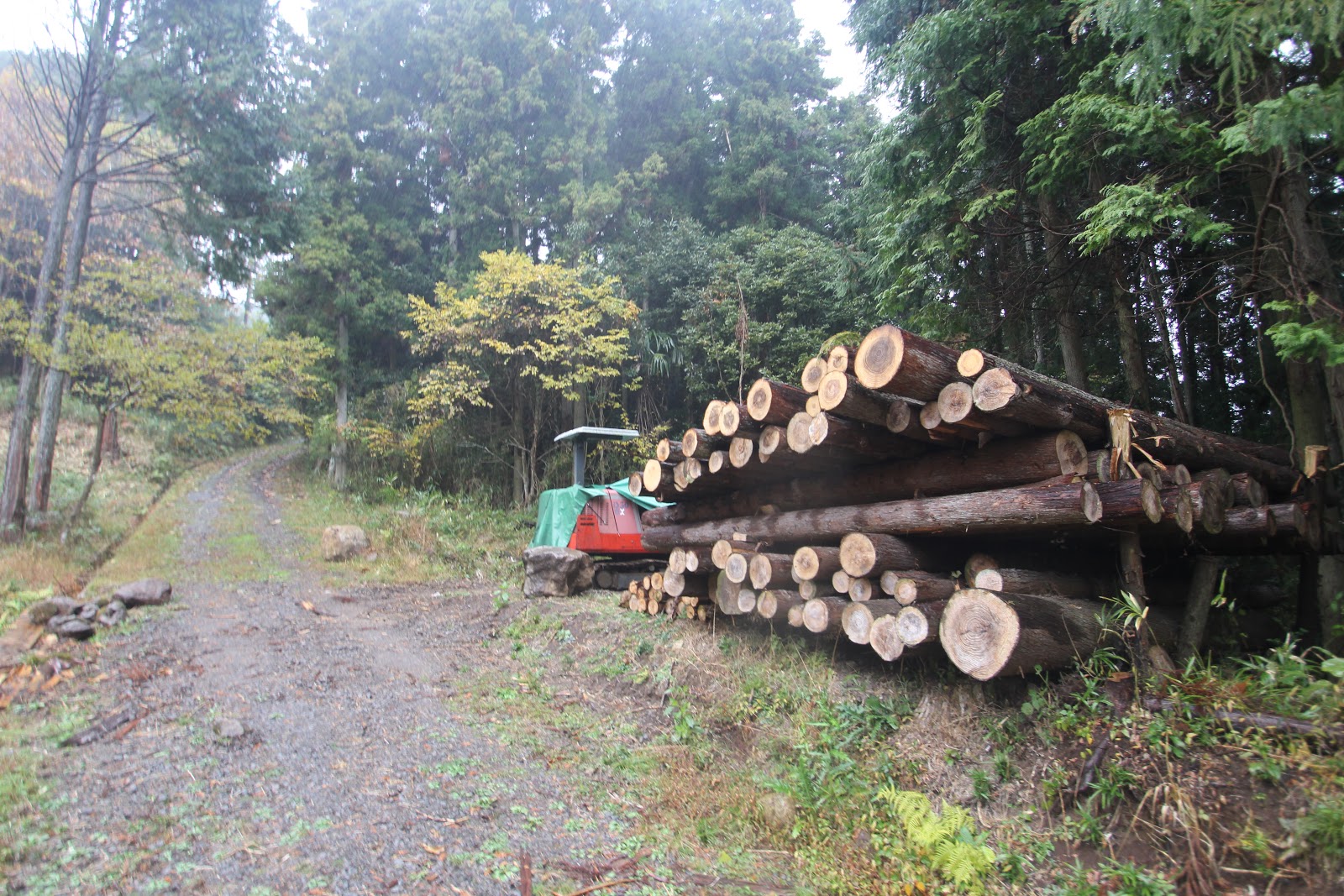
Earlier this year we felled a small cedar plantation of approximately one hundred trees - something I have been wanting to do for many years. By November we will have cleared all the timber from the site and stockpiled it before sending the best to the lumber mill. This coming winter we will begin the process of turning the vacant lot into a forest garden. Wikipedia succinctly explains forest gardening as...
'.... a low-maintenance sustainable plant-based food production and agroforestry system based on woodland ecosystems, incorporating fruit and nut trees, shrubs, herbs, vines and perennial vegetables which have yields directly useful to humans. Making use of companion planting, these can be intermixed to grow in a succession of layers, to replicate a woodland habitat.'
So over the next few years our small patch will be turned from a woodland of only two species of tree into a habitat of many different trees and plants providing a varied food supply and also a home to a range of wildlife (Though the plundering local deer and wild boar will be excluded!). In a small way, we are going to be flying in the face of the wisdom of Japanese Government policy of the last 60 years.

In the 1950s and 1960s Japan's post-war economic boom gathered pace and the demand and price of timber rose. The government urged everyone to plant trees, in particular two cedar species, hinoki and sugi. Both are used extensively in construction. TV news reports of the day show the Showa Emperor, shiny shovel in hand, planting saplings. Instilled with national pride and plied with subsidy money, dutifully the Japanese followed suit planting hundreds of millions of cedar saplings over the succeeding decades and in the process uprooted millions of acres of diverse forests (To be fair, they probably also planted some war-denuded landscapes). The march of the cedar also progressed over disused, stepped paddy and arable fields.

Over half a century ago, economic need spurred the cedar tree planting frenzy. Today, unfortunately, low timber prices, expensive labour and an ageing rural population mean that many of these forests - which should be just coming into their prime - are uncared for and are unlikely ever to produce good-quality timber, or be felled at all. Without thinning the trees and lopping their branches, the thick canopy excludes light from the forest floor preventing good growth of the best trees, most other plants and, in turn, any creature that might forage there.


Well tended for these forests can supply much of the timber that Japan uses and also sustain a reasonably diverse ecology. Instead, the verdant forest landscape of Japan consists to a large extent of a plantation monoculture that is under cared for and under used - a sort of organic rust belt.

In recent years, government policy on forestry has changed and a later post will address this. Please also look out for periodic updates on our forest garden.


Sunday, 27 May 2012

Puzzled in stone

 A couple of days ago a neighbour passed me on his tractor heading for his nearby paddy field. The usual nod of acknowledgement was quickly followed by an astonished look. His wife, riding behind on the trailer grinned broadly. I had just placed another rock in a stone retaining wall that has so far reached about 14 metres in length and up to 2 metres in height. ‘Amazing. Well done!’ he yelled out over the noise of the thumping engine. In the Japanese self-deprecatory fashion I shouted back ‘Maybe, but a crazy thing to do, eh?’. With broad grins the farmer and his wife nodded again and continued on their way to their field.

 I started my wall in June 2011. It is the latest in a series I have built and my most ambitious to date. I have carved the side of a slope to create a zig-zagging path up to Koumori-tei, Walk Japan’s main office in Japan, and the walls hold the whole thing up. As time passed my ambition grew and the wall has taken on greater dimensions than I first envisaged. A bad back has delayed work for a number of months but the other day I found the time to restart.
 

 The Kunisaki Peninsula has stone retaining walls throughout its length and breadth. Most give form to the stepped-paddy fields, while others provide a delightful frontage to house plots. Some are created of finely wrought stones that fit snuggly together; others of rocks in their irregular, natural state neatly and rhythmically placed against each other; some a rough stack approximating a wall; some are tens of centimetres high while other reach over four metres. The premiere style is the a beautiful concave façade once fashioned by master craftsmen. Most walls, however, were built up by the locals working together in the farming off-seasons. Unfortunately, few master craftsmen remain in the whole of Japan and retaining walls are now mostly built of concrete.  


So, perhaps, these days an amazing thing to see being built. And, yes a crazy thing to do. It takes an inordinate amount of time, overly heavy stones occasionally put backs out and sometimes fingers are painfully caught between a rock and a hard place. But as much as I want to quickly finish it, the wall cannot be rushed. The rocks create an intriguing puzzle that only patience and time can solve. Life can only but take on a gentle, meditative pace. About another 7 metres or so to go and with luck I might have it completed by the end of the year. To be continued....